Posts

Agent-based modelling to simulate cell- and multiscale problems in biology - Minisymposium at ECCOMAS 2024
Image
Our Technical Coordinator, Vasileios Vavourakis , and our Spokesperson, Roman Bauer , together with Mariam-Eleni Oraiopoulou , Arnau Montagud , Marco Manca , and Alfonso Caiazzo , are the organizers of the minisymposium " agent-based modelling to simulate cell- and multiscale problems in biology " , at ECCOMAS, 3rd-7th June 2024, in Lisbon (Portugal) . The purpose of this minisymposium is to act as a forum for investigators to present the state of the art in ABM in biology and life sciences, with a focus on pathophysiology of chronic (e.g., neuro-developmental and neurodegenerative disorders, cancer, diabetes, chronic inflammation) and communicable diseases (viral infections, parasitic disorders, etc.). Together, we aim to foster the exchange of knowledge and ideas across multiple disciplines: mathematics, physics, computer science, engineering, biology, medicine. We welcome contributions addressing challenges related to mathematical and computational modelling using ABM with...

Agent-based Modelling and Simulation for Biological and Medical Research

Image
 Our spokesperson,  Prof. Roman Bauer (University of Surrey) , has recently contributed to the success of the International Conference on Mathematical Physics and Computational Simulation by presenting about  Agent-based Modelling and Simulation for Biological and Medical Research. The recordings are now available to the public, and we are proud to share his lecture with you 😊

Surrey University's Combyne Lab gave a BioDynaMo tutorial during the (COST Action) NETSKINMODELS' training school

Image
On July 10-12, 2023 at the University of Surrey (Guildford, England, UK) , the COST action CA21108 European Network for Skin Engineering and Modeling (NETSKINMODELS) held its Training School 2023 Advancing skills in 3D skin and epidermal biology computer modelling  ( intended for PhD students and post-doc level researchers with at least preliminary programming skills and an excellent command in digital literacy ). The COMBYNE Lab was there.  Roman Bauer , Umar Abubacar , and Cayla Harris offered an introductory tutorial about BioDynaMo and the advantages that adopting a standardized and optimized general purpose agent based simulation suite can produce for the reproducibility and reusability of models and research. Following you can find the slides and transcript of a portion of the tutorial, kindly shared by COMBYNE Lab 's PhD student and BioDynaMo contributor Cayla Harris . We hope you find it interesting and useful (and don't hesitate to get in touch wit...

Bridging Scales: a Hybrid Model to Simulate Vascular Tumor Growth and Treatment Response

Image
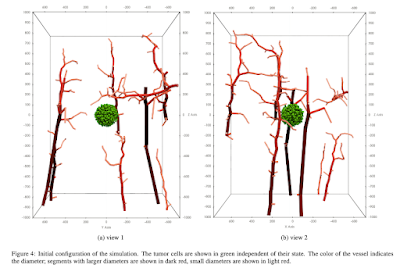
Tobias Duswald , Ernesto A.B.F. Lima , J. Tinsley Oden , Barbara Wohlmuth  have recently shared a very exciting pre-print going by the title " Bridging Scales: a Hybrid Model to Simulate Vascular Tumor Growth and Treatment Response " In their work the authors set to contribute to our understanding of tumour growth dynamics and, ultimately, to offer a tool to more effectively explore candidate treatment strategies, by exploiting computer simulations. In facts, the manuscript introduces a computational model to simulate vascular tumor growth, and its response to drug treatments, in 3D. It is based on two agent-based models for the tumor cells and the vasculature coevolving. The model focuses explicitly on breast cancer cells over-expressing HER2 receptors and a treatment combining standard chemotherapy (Doxorubicin) and monoclonal antibodies with anti-angiogenic properties (Trastuzumab). However,  large parts of the work presented can generalize to other scenarios. Very exc...

Modeling of radiation-induced lung injuries - a conversation with Nicolò Cogno

Image
Our Nicolò Cogno has been interviewed by Leon Kaysan , of TU Darmstadt's Friday Science Bites Nicolò talks about radiation therapy with heavy ions , and  soon dives into his efforts to develop agent-based models of radiation-induced lung damage (fibrosis) .  Listen to the conversation of Nicolò and Leon here . From about 10min32sec Nicolò gets down to talking about the learning curve involved in translating biology into computational rules, and the challenges of developing biologically realistic and medically relevant agent based models (he is currently pushing his simulations to 1 year of evolution after the "irradiation" for an alveolar segment, of the scale of 600um) ...but don't let us spoil the episode and do listen to the whole podcast, especially if you are a young researcher it's important to learn not just about the science but the human experience of a research endeavour ^_^

BioDynaMo presented at the French Regional Conference on Complex Systems 2023 by Umar Abubacar!

Image
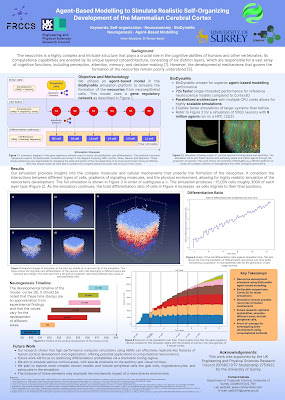
Umar Abubacar, from the "COmputational Modelling of Biological sYstems and engineering” (COMBYNE) at the Department of Computer Science of the University of Surrey , presented BioDynaMo at the French Regional Conference on Complex Systems (FRCCS), and we are glad to report there has been considerable interest particularly by collaborations working on urban development, and social media dynamics. The accepted poster showcased work supported by EPSRC DTP Studentship #2753922 (EP/R513350/1) . Umar's Doctoral project is focused on the intricate process of cortical development. Specifically, he is exploring how a layer of progenitor cells evolves into a layered cortex, by investigating the rules governing cells proliferation, differentiation, and migration. The simulation incorporates intracellular determinants and how they modify the response to external concentration gradients, echoing a biologically realistic process of human cortical development. The target of the simulation i...

A warm welcome to Oxford Cryotechnology, using computational methods for cryopreservation, and good luck to the founders!

Image
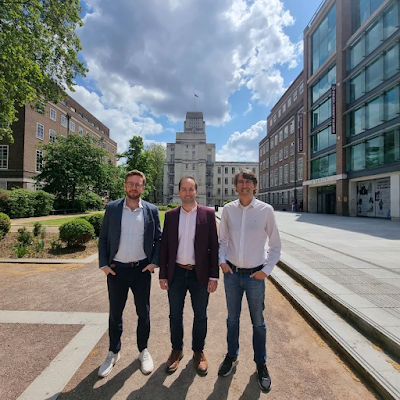
Oxford Cryotechnology is the new company founded by our spokesperson, Dr Roman Bauer , together with Prof. Joao Pedro de Magalhaes (University of Birmingham) and Dr Emil Kendziorra (Tomorrow Biostasis), to bridge the gap between research and practice gold standards in cryopreservation of cells, tissues and organs. The team behind Oxford Cryotech. From left to right: Dr Emil Kendziorra, Dr Roman Bauer, and Prof. Joao Pedro de Magalhaes. Oxford Cryotechnology will take advantage of a wide range of computational methods and in-silico modelling strategies building on recent work that resulted in CryoDynaMo [1] (supported by EPSRC grant # EP/S001433/1 ) , an extension of BioDynaMo that demonstrated the viability of agent-based modelling of cryopreservation protocols.   The new company will be heavily invested in continuing R&I in the field (see also [2]), and this will open to new opportunities of iteratively improving CryoDynaMo against data from new experimental setups. We at B...